
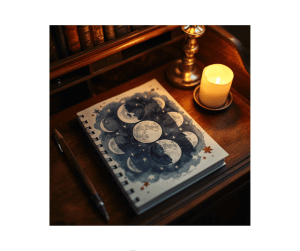
The Language of Dreams
Long before books, before clocks, and before the constant noise of modern life, our ancestors looked to dreams as a source of wisdom.
Dreams were considered messages from the divine, whispers from ancestors, glimpses into the unseen, and reflections of the soul’s deepest truths.
Today, many of us wake with fragments of dreams lingering just beyond reach—a feeling, a symbol, a place we cannot quite remember.
Dream journaling is the practice of capturing those fleeting moments before they fade, allowing us to uncover patterns, insights, and messages hidden beneath the surface of everyday life.
Whether you view dreams as spiritual experiences, subconscious processing, or a blend of both, keeping a dream journal can become a powerful tool for self-discovery.

Why Keep a Dream Journal?
Dreams often communicate through symbols, emotions, and stories rather than direct answers.
A dream journal helps you:
- Strengthen dream recall
- Identify recurring themes
- Notice spiritual patterns
- Explore subconscious thoughts
- Develop intuition
- Deepen your connection to dreamwork
Over time, your journal becomes a map of your inner landscape.
The First Rule of Dream Journaling
Write it down immediately.
Dreams can disappear within minutes of waking.
Before reaching for your phone, checking the time, or getting out of bed:
- Stay still
- Close your eyes
- Recall what you can
- Record everything
Even if all you remember is:
“I was standing in a forest and felt peaceful.”
Write it down.
Small details often become important later.

What Should You Record?
Many beginners believe they need to remember entire dreams.
You don’t.
Start with what you do remember.
Record:
Date
Tracking dates helps identify patterns over time.
Moon Phase
Many dream-workers notice stronger dream recall around the Full Moon.
Examples:
- New Moon
- Waxing Moon
- Full Moon
- Waning Moon
Emotions
How did the dream feel?
- Joyful
- Confusing
- Scary
- Peaceful
- Exciting
Often the emotion is more important than the story itself.
Symbols
Record anything that stands out:
- Animals
- Numbers
- Colors
- Objects
- People
- Places
Personal Reflections
Ask yourself:
“What was happening in my life when I had this dream?”
Common Dream Symbols and Their Meanings

Remember: Dream symbols are deeply personal.
A snake may symbolize transformation for one person and fear for another.
However, some symbols appear frequently across traditions.
Water
Often connected to emotions, intuition, and the subconscious.
Birds
May represent freedom, messages, or spiritual guidance.
Keys
Often symbolize opportunity, knowledge, or unlocking hidden truths.
Forests
Can represent mystery, growth, and the journey inward.
Houses
Often symbolize different aspects of the self.
The Moon
May indicate intuition, hidden knowledge, or spiritual awakening.
Decoding Your Dreams
Many beginners rush to find dream dictionaries.
While these can be useful, your own intuition should always come first.
Instead of asking:
“What does this symbol mean?”
Ask:
“What does this symbol mean to me?”
For example:
If you dream of a crow, consider:
- What emotions did it evoke?
- What do crows represent in your personal beliefs?
- What was the crow doing?
Dream interpretation is often about context rather than fixed meanings.
Creating a Dreamwork Ritual

You Will Need
- Journal
- Pen
- Moonstone or Amethyst
- White candle (optional)
Before Bed
Take a few quiet moments.
Hold your crystal and say:
“I welcome meaningful dreams and clear messages.
May I remember what serves my highest good.”
Place your journal beside your bed.
The intention itself helps strengthen dream recall.
Moon Phases and Dreamwork
The moon has long been associated with dreams, intuition, and the subconscious mind.
New Moon
Dreams may reveal hidden desires and future intentions.
Waxing Moon
Dreams often focus on growth and possibilities.
Full Moon
Dream activity may become more vivid, emotional, or symbolic.
Waning Moon
Dreams may help release old patterns and unresolved emotions.
Tracking moon phases alongside your dreams can reveal fascinating patterns.
Crystals for Dream Journaling
Moonstone
Enhances intuition and dream awareness.
Amethyst
Supports spiritual insight and peaceful sleep.
Celestite
Encourages dream exploration and inner calm.
Labradorite
Associated with intuition and spiritual discovery.
Selenite
Creates a peaceful environment for dreamwork.
Dream Journal Prompts
When reviewing your dreams, ask:
- What emotion stands out most?
- Is there a repeating symbol?
- What lesson might this dream be offering?
- What part of my waking life does this resemble?
- Is my intuition trying to draw attention to something?
These questions often reveal insights that are not immediately obvious.
When Dreams Repeat
Recurring dreams are often invitations.
They may point toward:
- Unresolved emotions
- Personal growth opportunities
- Patterns that need attention
- Lessons still unfolding
Instead of fearing recurring dreams, approach them with curiosity.
Ask:
“What are you trying to teach me?”
Building a Dream Practice
Dream journaling is not about becoming an expert overnight.
It is about building a relationship.
The more attention you give your dreams, the more they seem willing to speak.
Some mornings you may fill pages.
Others you may only remember a single image.
Both are valuable.
Trust the process.
Closing
Every night, we cross a threshold.
We leave the familiar world behind and enter landscapes shaped by memory, emotion, intuition, and mystery.
Dream journaling is an invitation to bring a small piece of that wisdom back with you.
Listen closely.
Write often.
And remember that some of the most profound messages we receive arrive not in the light of day, but beneath the watchful gaze of the moon.