
More Than a Table: Understanding the Purpose of an Altar
Long before modern spiritual practices found their way online, sacred spaces existed in homes, forests, temples, and hearths. These spaces served as bridges between the physical and spiritual worlds—a place where intention, prayer, ritual, and reflection could take root.
An altar is not simply a collection of beautiful objects.
It is a sacred focal point.
A place where you return to yourself.
Whether your practice centers around the moon, the seasons, ancestral connection, divination, deity work, or simple mindfulness, an altar creates a dedicated space for your energy to gather and grow.
The most powerful altar is not the most expensive or elaborate.
It is the one that feels alive to you.
Choosing the Location of Your Altar
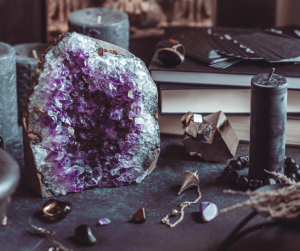
Your altar can be as simple or elaborate as you wish.
Some common locations include:
- A small table in a quiet room
- A bookshelf or dedicated shelf
- A dresser top
- A windowsill
- A seasonal outdoor altar
When choosing a location, ask yourself:
- Can I spend time here comfortably?
- Does this space feel peaceful?
- Can I keep it relatively undisturbed?
Remember, sacred space does not require an entire room.
Even a small corner can become a powerful sanctuary.
The Foundation of Your Altar
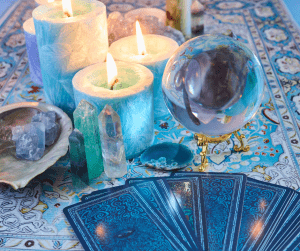
Many practitioners begin with a simple altar cloth.
This creates a visual boundary and helps distinguish sacred space from everyday life.
Consider colors that align with your intentions:
- White for purification and spiritual connection
- Black for protection and mystery
- Green for abundance and growth
- Purple for intuition and psychic work
- Blue for healing and peace
Natural fabrics such as cotton or linen often feel especially grounding.
The Four Elements on the Altar
One traditional way to build an altar is through the energies of the four elements.
Earth
Represents stability, grounding, abundance, and physical manifestation.
Examples:
- Crystals
- Stones
- Salt
- Plants
- Herbs
Air
Represents wisdom, communication, and inspiration.
Examples:
- Incense
- Feathers
- Bells
- Wind symbols
Fire
Represents transformation, passion, and action.
Examples:
- Candles
- Lanterns
- Fire-safe cauldrons
Water
Represents intuition, emotion, and healing.
Examples:
- Bowl of water
- Moon water
- Seashells
- Chalice or cup
You do not need every element immediately.
Allow your altar to evolve naturally over time.
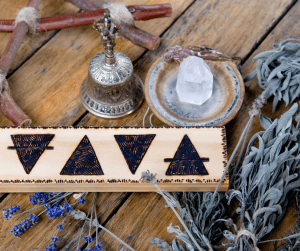
Essential Altar Tools
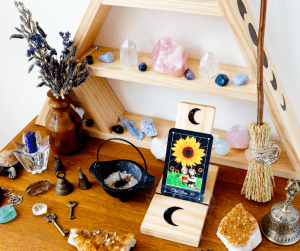
Many beginners wonder what they “must” have.
The answer is surprisingly simple:
Nothing.
Your altar can begin with a single candle and a clear intention.
However, common altar tools include:
Candles
Used for focus, manifestation, protection, and honoring spiritual energies.
Crystals
Chosen for their energetic correspondences.
Popular beginner crystals include:
- Clear Quartz
- Amethyst
- Rose Quartz
- Selenite
- Black Obsidian
Herbs
Herbs connect us to the wisdom of the earth.
Consider:
- Rosemary for protection
- Basil for abundance
- Lavender for peace
- Cinnamon for manifestation
- Cloves for empowerment
Divination Tools
- Tarot cards
- Oracle decks
- Runes
- Pendulums
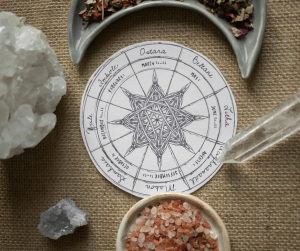
Seasonal Altars and the Wheel of the Year
One of the most beautiful ways to work with an altar is to allow it to change with the seasons.
During spring:
- Fresh flowers
- Seeds
- Green candles
During summer:
- Sunflowers
- Herbs
- Gold accents
During autumn:
- Leaves
- Acorns
- Harvest symbols
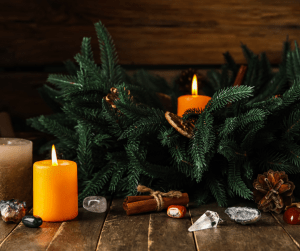
During winter:
- Pinecones
- Evergreens
- White candles
Your altar becomes a living reflection of nature’s rhythms.
Moon Phase Altar Ideas
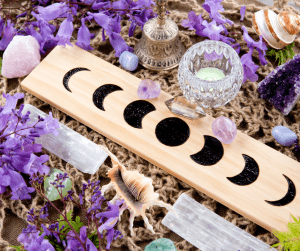
New Moon
- Black or silver candles
- Intention journals
- Moonstone
Waxing Moon
- Green candles
- Prosperity herbs
- Citrine
Full Moon
- White candles
- Charged crystals
- Divination tools
Waning Moon
- Black candles
- Protection herbs
- Obsidian
Aligning your altar with lunar cycles helps deepen your connection to the natural flow of energy.
Cleansing and Maintaining Your Altar
Like any sacred space, your altar benefits from regular care.
You can cleanse it by:
- Dusting and physically tidying
- Using sound (bells, chimes, singing bowls)
- Burning cleansing herbs
- Sprinkling salt around the space
- Using moon water
Remember that maintenance is also an act of devotion.
Every time you tend your altar, you strengthen your relationship with it.
Your Altar, Your Practice
There is no perfect altar.
There is no universal checklist.
There is only the sacred relationship between you, your intention, and the space you create.
Let your altar grow as you grow.
Add pieces that hold meaning.
Remove what no longer resonates.
Follow your intuition.
Over time, you may discover that your altar becomes more than a place where you practice your spirituality.
It becomes a place where you remember who you are.